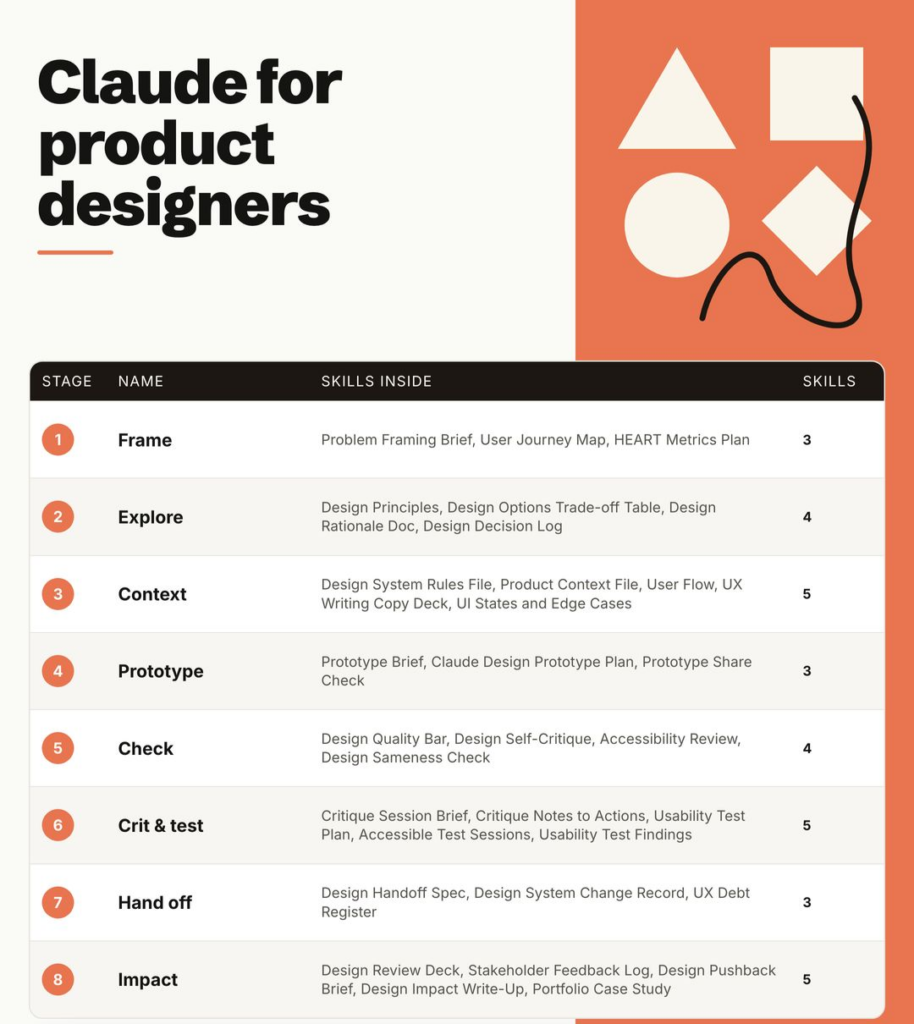
How the top 1% of product designers use Claude.
1/ Frame the problem
Problem framing brief, user journey map, HEART metrics plan.
Design success is agreed before the first screen.
2/ Explore and decide
Design principles, options trade-off table, design rationale doc, design decision log.
Reviews argue principles, not taste, and old decisions keep their reasons.
3/ Design with context
Design system rules file, product context file, user flow, UX writing copy deck, Ul states and edge cases.
Claude works from your system instead of inventing values it lacks.
4/ Prototype
Prototype brief, Claude Design prototype plan, prototype share check.
No prototype can pass for the real product.
5/ Check the work
Design quality bar, self-critique, accessibility review, sameness check.
Nothing is called accessible just because an automated check passed.
6/ Crit and test with users
Critique session brief, critique notes to actions, usability test plan, accessible test sessions, usability test findings.
Real users test the work, and findings say who failed the task.
7/ Hand off
Design handoff spec, design system change record, UX debt register.
Engineering can tell which design is final.
8/ Defend and show impact
Design review deck, stakeholder feedback log, pushback brief, impact write-up, portfolio case study.
You make the design decisions, including saying no to a deceptive pattern.
Guide: